Burned-in subtitles: when they earn their place in a short video

Most short video is watched with the sound off, which makes subtitles the default. "Default" is not the same as "always", and the exceptions are worth knowing.
Somebody is watching your video in a queue with the sound off. That sentence is the whole argument for subtitles, and it is a strong one: if the joke is in the dialogue and the dialogue is inaudible, there is no joke. Burned-in captions - baked into the pixels rather than attached as a track - are what survive re-uploads, screen recordings and platforms that ignore caption files.
So subtitles are usually right. The interesting part is the "usually".
When to burn them in
- The line is the punchline. Anything where the words carry the beat.
- Fast dialogue between two characters. Generated voices are not always crisp, and a viewer who misses one line has missed the exchange.
- Accents, names, invented words - anything a listener could hear correctly and still not parse.
- Anything going to a feed that autoplays muted. Which is most feeds.
When to leave them off
- Scenes with no dialogue. A caption over a silent reaction shot is furniture.
- Sight-gag scenes where the frame is the joke and text competes with it.
- Shots with something important at the bottom of the frame - captions sit exactly there.
- Openers where you want the first second to be pure image.
This is why the setting is per scene rather than per video. A three-scene skit is often two scenes of dialogue and one wordless reaction, and the reaction shot is better clean.
The rule that saves you money
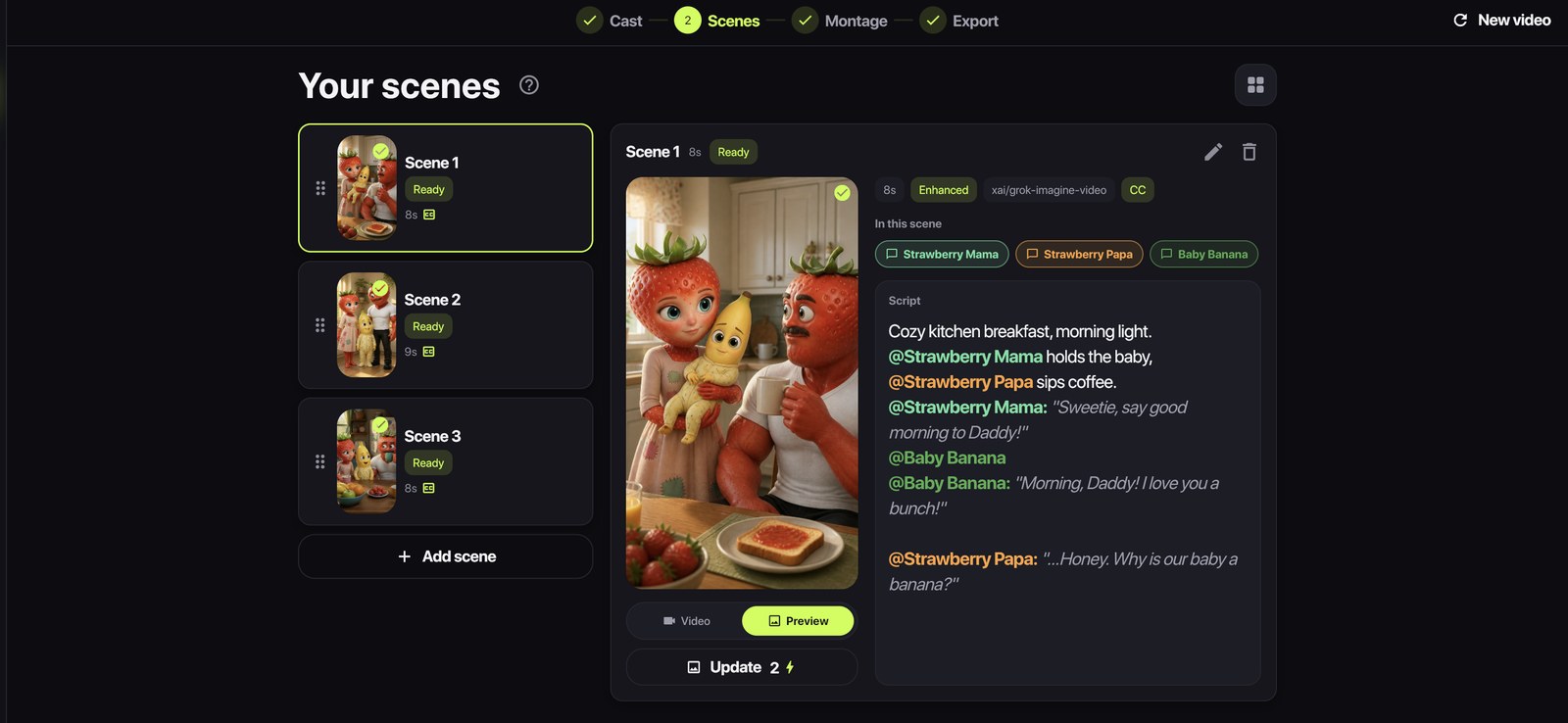
Subtitles are transcribed from the dialogue in the scene, which means a scene with no spoken lines has nothing to transcribe. Asking for them anyway would be paying for a feature that cannot do anything, so a silent scene will tell you as much rather than quietly charging for it - the switch says it needs dialogue.
Worth knowing when you plan a video: if you want captions on a beat, that beat needs a line. A stage direction is not dialogue.
Write shorter lines and the captions look better
Captions are the second reason to keep spoken lines short. A twelve-word line becomes two or three stacked rows of text across the middle of a vertical frame, and a vertical frame does not have room to spare. Six to eight words per line reads as one clean row - and the same discipline makes the dialogue land better anyway.
Two habits that consistently improve captioned videos: split a long line into two short ones spoken by the same character across two scenes, and cut the greeting. "Hey, so, I was thinking maybe we could" is four rows of caption and no information.
Check the frame, not the setting
The last step is the one people skip: watch the clip once with the sound off. Not to check that subtitles are enabled - to check that the video works muted. If it does, you have a short video that survives the way short video is actually consumed. If it does not, no caption setting will save it.